Sunday, August 07, 2011

All the Statham, all the time

Cellular

This is a great bubblegum thriller with Chris Evans well cast as the beachboy himbo Ryan, suddenly thrust into responsibility as he races around LA trying to help Kim Basinger’s kidnapped Jessica. She’s in a room with a bust phone but managed to get it working enough to dial a random number - Ryan’s. As he slowly realises that she is genuine and not some crank calling nutso, he goes to increasing extremes to try and save her and her family.


Statham is the lead kidnapper and does a decent job of being the main bad guy without dialling up the evilness element too much. To be fair it’s not a far cry from most of the roles he plays, only this time he’s hurting good people instead of bad. He does a much better job than many others placed in a role where he’s identified as crooked from the off, not hamming it up or trying to act overly twisted. Shame that he attempts to do an American accent.
It has a fairly starry cast - alongside Evans and Statham, Basinger is excellent as the women pushed to desperate acts, Jessica Biel pops up in a couple of scenes as Ryan’s ex, William H Macy steals the show as the cop nearing retirement in not quite the usual way, and there is a lovely turn by Rick Hoffman as a prissy lawyer who has his car jacked twice.

The movie zips along at a breathless pace as Ryan is forced to speed across the city in an effort to help Jessica escape. The tension exceeds on the whole as while a happy ending is a pretty safe bet it’s not a certainty that you won’t lose someone along the way. Evans is charming in the lead and helps the audience to keep up with a guy who spends a lot of time on the phone in a car, but it really is Macy’s movie.
As he says towards the end, “It’s a day spa you fuck!”.


-

In The Name Of The King: A Dungeon Siege tale


 So, Uwe Boll. He was universally panned in the eyes of gamers as his career as a film director seemed to hinge on taking a video game property and churning out crappy adaptations to make a quick buck. Starting with House of the Dead in 2003, then Alone in the Dark, BloodRayne, Dungeon Siege, Postal and Far Cry followed, with two sequels appearing for BloodRayne (USP: she’s a sexy vampire who kills nazis) and one for the Dungeon Siege adaptation.

The first Dungeon Siege film kept the video game name as a subtitle, preferring to go by the generic In the Name of the King, a title that could have been a gritty, made-for-TV British thriller set in Georgian England if made in the 80s, instead this 2007 production took a lot from the fantasy genre resurrected by Peter Jackson’s Tolkien adaptations. We may know of the likes of Dungeons and Dragons which popped up to ride the bandwagon, but ITNOTK seems to come late in the day, 6 years after the Fellowship first started their journey to Mordor.

The film is unsurprisingly poor, cack dialogue that nothing can save despite a pretty starry cast, generic settings that try and evoke the sweep and vision that Jackson created without his visual flair or budget, and an empty plot which basically involves a naughty mage forming an army of Krugs (Orcs) to take over the Kingdom and generally be evil. The motive he gives is that his new reign will redefine madness as power.
Statham plays the lead, called Farmer, who inexplicably is a complete badass without any military background in the usual ‘ex-special forces but now leading a quiet life’ cop-out. His lack of surprise at his ability to hold his own against a small army of rampaging Krug is odd, and his abilities are later explained by his being the King’s long-lost son.
So if the story is the pits, you’d probably just be hoping for some decent imagery or set-pieces to keep the film rolling, but no.
And yes, you read it correctly, Statham is called Farmer. Because he is a farmer, and the character believes that what you do defines you. If it wasn’t for the inexplicable ninjas that are the king’s personal guard (yes, LOTR with ninjas and it’s not good), or the tree women who swing about on vines and evidently decided that having pointy ears was a step too far, calling the hero Farmer would be one of the worst elements of the film, even more so than the cheap, crappy suits and masks that the actors playing the Krug wear.

So, that cast. It’s really hard to explain what happened here, was everyone blackmailed? Uwe Boll hardly had a glowing track record at this point and game properties were hardly prestige projects - about the only success was Tomb Raider 6 years previously, and ITNOTK was a few too many years late to ride on the association of the LOTR films.
Still, alongside your Statham, Boll managed to acquire Leelee Sobieski (almost successfully acts like she’s in a different, better film), John Rhys-Davies (evidently did not make enough from the Indy and LOTR films to avoid saying yes to the likes of this), Ron Perlman (seems to just like working), Claire Forlani, Burt Reynolds who just seems tired here, Ray Liotta who at the very least is enjoying himself hamming it up big style, but seems oddly out of place, and Matthew Lillard who is way too successful portraying the extremely irritating and treacherous King’s nephew.


 There are good points. The CGI used by Rhys-Davies’ magus when he disintegrates into mist to move through walls is quite good, and Liotta is almost worth watching in a sub-Nicolas Cage gurning competition way, but the film is ultimately as boring and pointless as Will Sanderson’s rubbish Legolas wig.

Thankfully this might be the worst I’d yet to see on Statham’s list.

Thursday, July 28, 2011

In Statham We Trust

The Mechanic (spoilers, though if you really care you are a fool)


      Statham is not happy being near steps. Or decking.

A bad man is driven home by some goons. His goons are mean to poor people on the way. At home he goes for a swim. His many guards do not see Jason Statham in the pool. Statham kills the bad man, then escapes. Statham gets angry at CLOTHES. Statham pays for sleeping men to look after his boat with LIQOR.
Statham meets a sexy young lady who is happy to see him scowl when he arrives at some 30s style speakeasy bar. Statham has sex with her looking ANGRY. Statham has NEVER told her his name.
Statham meets a friend, his only friend Donald Sutherland, in a cheap diner. Statham looks angry at the very IDEA of diners. Statham’s boss sends him a message that next he needs to kill his friend. Statham looks angry. His friend sends him a private jet so he can tell him to kill his friend in person. Statham looks angry. Statham kills his friend. Statham meets his friend’s wayward son at the otherwise deserted funeral. The son looks like a fool compared to the MANLY Statham.
The son is played by Ben Foster. Ben Foster looks like the older brother of Screech from Saved by the Bell. They did not NEED to cast Ben Foster in this role to make Statham look manly. Statham would look manly next to THE ROCK.
Although Statham is a hard man, he does feel SOME guilt for killing his friend. This is because he is COMPLEX.
The son acts stupid because of what he thinks happened to his dad. Statham killed him to make it look like carjackers. Statham stops the son from making a big mistake. The son wants Statham to teach him how to be within SNIFFING distance of his manliness.
Statham makes the son look after an emasculating dog.
Statham KILLS a man because he doesn’t like his slovenly appearance, and makes it look like a porn related ACCIDENT.
Statham sets up the son on his first hit because he looks like queer bait. The son doesn’t follow orders about how to take out his mark. The son DOES NOT know best.
Statham does. The son wins but only after a bad beating. Statham obviously only keeps him around begrudgingly, because he is COMPLEX.
Statham and the son climb a skyscraper to plan a fat man’s death. The fat man is a baddie because he doesn’t tell jokes. He may have also killed an innocent girl and greedily built a new age empire whilst being a junky, but mainly he’s bad because he’s FAT and NOT FUNNY.
After the fat man and MANY of his henchmen are dead, Statham finds out the boss LIED about his friend.
After dispatching a double-crosser on an empty BUS, Statham kills other, lesser hard men who have killed his LIQOR DRINKING BOAT MINDER. The son does a good job of taking out similar bad guys at Statham’s house. The boss means to kill them!
The son realises who killed his dad. Statham tells him “There is no peace”.
Statham goes after the boss. The boss says “He’s in the building get me the fuck out of here!”.
The boss leaves his building in a convoy but is not safe, as Statham and the son have big guns, a bus and a garbage truck.
Statham wins.
BUT. The son enacts revenge. listens to his music. Drives his car. Can Statham have lost. NO.

On July 28th, 2011, Funny or Die posted a video of a spoof charity appeal for Netflix users featuring a man in tears at the prospect of not being able to watch all of Statham’s films in which he portrays a hitman. This was also the day I happened to choose to watch the Mechanic.

As action film’s go, it’s average. As Statham’s films go, it’s average, achieving neither the kinetic thrills of the Transporter series nor the sheer lunacy of the Crank films. It’s an also-ran and it’s hard to see how it ascended from it’s straight-to-retail/rental feel to a cinema release, but then maybe that’s because Statham’s the MAN.

Tuesday, June 14, 2011

Munchies made to make your mouth indifferent

Munchies


The chocolate isn’t particularly spectacular, a standard milk chocolate that doesn’t have the taste and texture of that used in Cadbury’s Wispa, said to be made in Ireland from a different recipe from that produced in the UK. The caramel inside again offers little to stand out from other fillings found in Cadbury’s Caramel, for example, or those found in Quality Street. The biscuit ball centre is an insufficient size to have a significant impact on the overall experience, unlike the serious biscuit-based chocolates such as Twix or Penguin.
The individual topless pyramids do have an aesthetically pleasing aspect, but there isn’t enough of a difference here from, say Rolos.

So why are Munchies consistently one of the most expensive mainstream chocolate confections? With no luxury element, no special ingredients or packaging (just the paper sleeve and inner metallic paper lining) and no excuse of using Fairtrade ingredients (as the Cadbury’s Dairy Milk bar now does), it seems a mystery why Nestle seem to seek to position this product ahead of the pack.


Munchies were originally made in 1957 by the Rowntree Mackintosh company, who were then taken over by Nestle in 1988.

There is a facebook page dealing with this very topic. I am not one of the 21 (as of 22.05.2011) members.

I emailed Nestle customer services about the pricing policy, here’s what they said:


                                002893671A                  23 May 2011


Dear Mr Taylor

Thank you very much for your email.

In answer to your enquiry, our recommended resale price for Munchies is generally around 67p. We can only recommend a resale price as the retailers are free to charge whatever they think is appropriate for the product.

Thank you once again for taking the time and trouble to contact us. Your comments have been carefully noted.

We hope this information will be helpful and thank you for your interest and loyalty to our products.

Yours sincerely


**** *******
Contact Centre Executive
Consumer Services

Not really a help.
Any key in the ingredients to explain the expense?
Milk chocolate is made from: Sugar, cocoa butter, skimmed milk powder, cocoa mass, lactose and proteins from whey, whey powder, butterfat, emulsifier (soya lecithin), natural vanilla flavouring), Caramel from: Glucose-fructose syrup, sweetened condensed skimmed milk, vegetable fat, sugar, salt, Biscuit from: Wheat flour, sugar, vegetable fat, cocoa butter, dried whole milk, cocoa mass, whey powder, barley malt extract, lactose, raising agents (sodium bicarbonate, ammonium bicarbonate), salt, emulsifier (soya lecithin).


So no, then. Pretty standard stuff, no gold leaf, no ground blood diamonds.

I love the nutrition information though, "Per 1/2 tube 133 calories" because you would just eat half the tube and then carefully wrap the rest up for another day. No.

Oh well, it'll always be a mystery but that last sampling hasn't persuaded me to make the small economic leap for potential confection satisfaction.

Sunday, May 08, 2011

Hooah


Call of Duty: Modern Warfare 2

After the block-busting success of the first Modern Warfare iteration of the Call of Duty franchise, and fourth in the series, a direct sequel was inevitable. The first three games were successful takes on the World War 2 first person shooters that had gained popularity since the Medal of Honour games arrived on the Playstation, but Modern Warfare saw the series leave history behind to plump for a ‘near future’ take on conflict.
Rather than attempting to capture the feel of present day warfare, CoD 4 opted for a globe trotting action-fest which split missions between different military forces and perspectives (mixing mainly ground-based first person segments with aircraft fire support via grainy camera footage, for example). In its desire to deliver the big thrills it even included the aftermath of a nuclear explosion, albeit in a mainly scripted form.

This forced perspective is used fairly liberally in the follow up, with a couple of key sequences seeing your avatar fairly helpless and forced to observe the action with little chance for input, allowing the developers to keep you locked in on the narrative rather than wander off and look at the sky while something important happens.
Despite the mainly linear nature of the game and the use of inter-mission briefings to push along the distinctly 80s plot the message is still a little garbled with little background before you’re suddenly in the shoes of a CIA mole in a Russian terrorist’s gang, following as they gun down dozens of civilians in a Moscow airport.
The outrage sparks a war between Russia and the US, allowing the game to flit between the efforts of ground troops trying to reclaim heartland USA and special forces trying to hunt down the terrorist behind it all in clearly defined locations - a Rio favela, an oil rig, snow-bound military base, forest compound etc.

Whilst the plot wouldn’t look out of place in one of the more ambitious actioners fronted by the likes of Seagal or Van Damme in their heyday, the game offers undeniably exhilarating action as you often find yourself scrambling between cover, a near-overwhelming enemy force crawling out of the woodwork and taking out members of your AI controlled team. On the higher difficulty settings the intensity is almost too much, forcing you all too frequently to dive behind walls as the screen goes blurry and blood-smeared in the preferred way of announcing imminent death since games achieved the visual fidelity to do away with health bars.

On normal difficulty the campaign can be breezed through within a day of solid gaming, but aside from the challenge of going back to find the in-level collectables (intel), there is also a series of one-off ‘special ops’ missions which utilise certain play styles (stealth and sniping, riding a snow-mobile, defusing bombs against the clock) and have more of a score attack feel as they tempt you to go back for short bursts of action and beat you previous performance.

What has made the series a success, however, is the combination of hardware ownership and broadband access at the time of release that gave enough consumers the option of taking the game online in order to shoot friends and strangers in the face. I’ve no doubt that it’s a very polished aspect but not having played online for about three years (partly due to a stint of poor net access and partly due to the many late nights with Halo 3 and the like) I wouldn’t know.

Without this element CoD: Modern Warfare 2 is a highly polished shooter which offers up enough of a challenge to keep FPS fans happy, fairly decent AI and varied levels which manage to disguise the open corridors with some gorgeous artwork. It stands up well in a crowded market, but as a single player experience it’s not special enough to compete with the likes of the innovative Oddworld: Stranger’s Wrath or the daddy of single player FPS’s, Half Life 2.

Monday, April 25, 2011

Wouldn't you like to be a Pepper too?

 I love Short Circuit.

I'm not sure why I always thought that Dr. Pepper would have a peppery taste, probably the name and the ad campaigns that try and persuade people to give it a try, as if it's the leper of the fizzy drink world. 


Dr Pepper Zero
This smells a lot like cherry cola, but not much of a head compared to diet Coke.
Fruity taste, not a hint of a pepper's heat or sweetness. Less harsh than cherry Coke (not so much of that artificial flavouring) so a nice alternative in the fizzy pop world. From the ad tagline “What’s the worst that could happen?” you would expect a taste a little more divisive than vague fruitiness.


Diet Dr Pepper Cherry

Barely has more than a hint of a cherry odour beyond the normal Dr Pepper fruitiness, but the one different ingredient from the usual cola additives, ‘Red 40’, probably contributes to the reddish tinge to the usual dark caramel brown and a strong, dark pink colour to the bubbles (while they last).
The smell once in a glass is no stronger, the cherry having less of the artificial feel found in cherry Coke.
I can barely detect more of a cherry flavour than the general ‘fruity’ flavour that Dr Pepper has as standard, so what this is giving the Pepper devotee I have no idea. Shiny can?


Dr Pepper Diet Cherry Vanilla

The cherry smell is lighter than the non-vanilla version, so barely there. Red 40 is still present so the red tinged bubbles are still in effect in the intial froth build.
Rather than the vanilla adding anything to the mix, instead all tastes - fruit, cherry, vanilla, seem to cancel each other out and the drink seems like sparkling water with a vague, undefinable aftertaste. Very poor.

Dr. Pepper makes for a nice, fruity alternative to that sweet cola tang I seem to be vaguely addicted to, better than the straighter tastes of your Fantas and Sprites, and with less of an artificial hit than Cherry Coke. Nowhere near a diet vanilla coke beater though, that so called 'vanilla' cherry Dr. Pepper is a massive let down.

Sunday, March 20, 2011

Drown your spirits

Crabbie's

Crabbie’s alcoholic ginger beer has a stout, impressive looking bottle, trying to emulate the kind of vessel associated with real ale.

On first crack there is a light, spicy aroma of ginger, the head is very impressive and the  amber tint neither too cloudy nor too clear - the substance is there but it’s not all sediment. On tasting, however, the beverage is deceptively light. Crisp and benefitting from being chilled, the ginger taste itself is very mild, even if it does linger, and the bubbles aren’t really in evident. The drink is a very easy one, and it’s a wonder that there was any need for the invention of alcopops at all if this were an available alternative. With none of the bitingly sweet tones of the chemically enhanced likes of WKD and Smirnoff Ice, this feels like a much more preferable choice for those who prefer their alcohol to be sweet rather than bitter, even though the ingredients do point to the use of sulphites, sugar and sweeteners. Much is made of the elephant trademark dating back to 1801 and the emblazoned statement in ‘original’ ginger beer, but the ingredients are unlikely to set this far from the alcopop crowd. Still, this is ahead in taste and I would recommend for those who are after a refreshing brew with a light kick (4%).


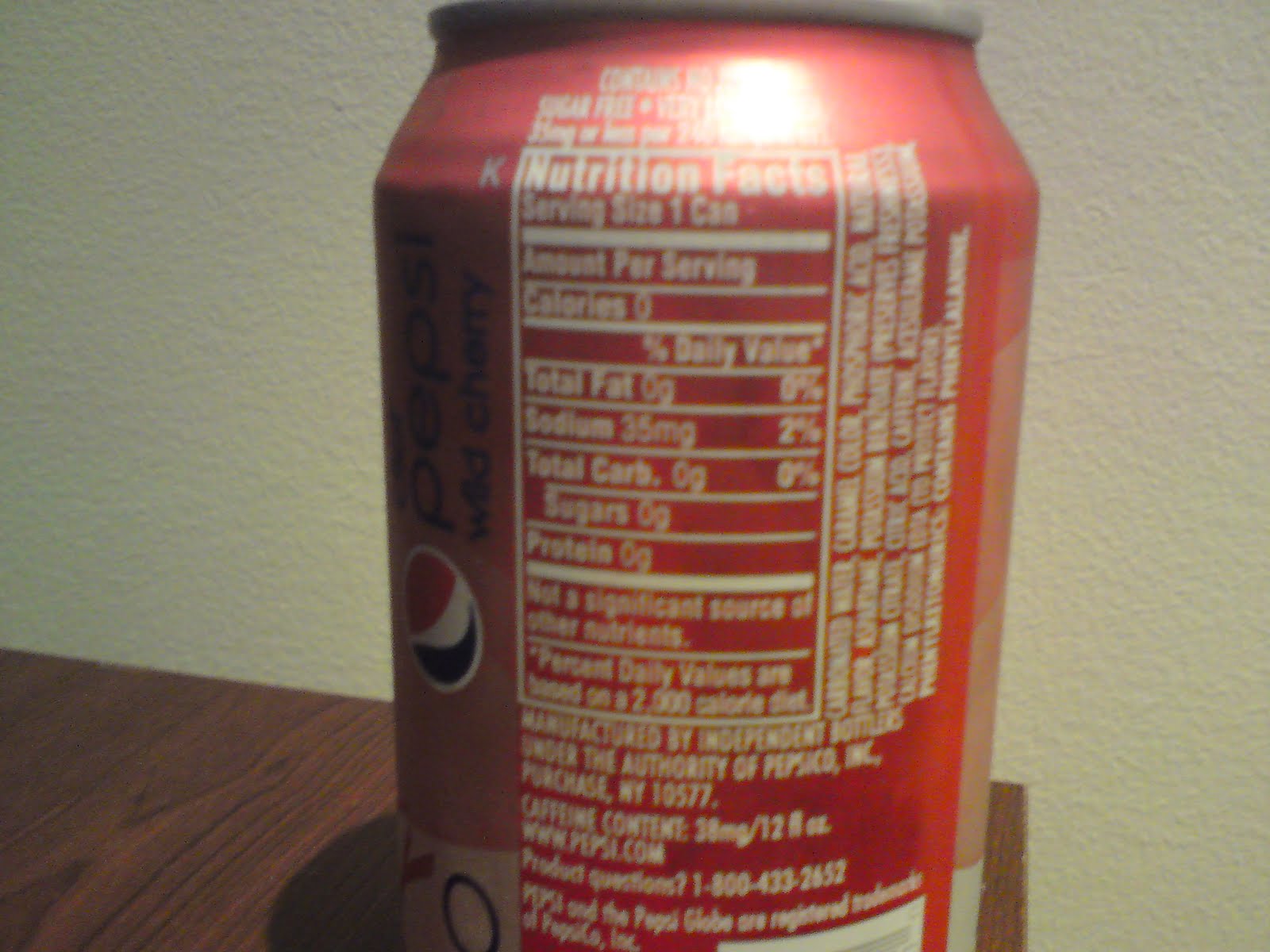
Diet Pepsi Wild Cherry

On cracking there’s only the faintest hint of cherry, certainly not the sweet tang of cherry drop boiled sweets I’d associate with flavoured cola. The high fizz factor of a diet cola is present and correct, but the large head soon gives way to a tamer brew with that familiar brown-hued darkness to the liquid. With the drink loose in a pint glass the cherry aroma is no stronger than from the can; the first taste isn’t 100% smooth, but there certainly isn’t that acidic hit you’d get from a badly made artificial flavour. As with the odour, the taste is light, supplying an edge to the usual diet pepsi taste, doing the job of adding highlights without overwhelming the original. This is something I could get used to, if it were a standard addition to most shops’ pop lockers.


The ingredients feature the usual suspects with only calcium disodium an unfamiliar addition. Crucially the can states ‘contains no juice’ in order to cover themselves against people assuming that the use of ‘wild’ and ‘with other natural flavours’ goes hand in hand with organic or the drink being good for you.


Guarana Antarctica

Subtitled O Original Do Brasil, so I’m assuming that this is Portuguese and it’s a Brazilian drink with guarana as a chief ingredient. Guarana was marketed in the 90s, before Red Bull achieved fame, as a natural stimulant, appearing in drinks and chewing gum with promises of alertness. I tried the gum but don’t remember it having any particular effect

That ingredient list is dense as hell.


On cracking the can there’s a quick citric whiff, but this weakens quickly. The fizz on pouring is moderate, with a small head that subsides almost immediately. The colour isn’t that appealing, piss yellow in keeping with energy drinks but slightly less radioactive looking than red bull.
The odour in a glass is less citrus and more sugary, hinting at syrupy thickness. IT goes down smooth though, the sugar not leaving an unpleasant coating and a taste somewhat like muted lime. This does taste more natural than your average buzz beverage.


Tab

Made by the coca cola company, this beverage smells a bit like diet coke on first cracking the can, it looks like diet coke after you first pour, and it also tastes like diet coke, albeit with an unpleasantly metallic/soily aftertaste. I remember Tab clear being basically a way of having clear cola, but I can’t see the point in Tab at all.


Diet A&W root beer

On the crack you get a strong whiff of liquorice, very reminiscent of dental mouthwash. Whilst the gloop looks like your standard cola in the glass that medicinal taste is overpowering, with only a hint akin to sweet caramel from the ‘aged vanilla’ underneath.
Not something I’d like to sample again, definitely a stronger taste than the naturally brewed root beer I’ve tried before.

Metro 2033 - Xbox 360


Metro 2033 is heavily based on the novel by Dmitry Glukhovsky. In 2033 a nuclear war has resulted in Moscow becoming an irradiated wasteland populated by mutated creatures, whilst the surviving people live underground in the metro systems tunnels and stations. The player controls a typically mute character Artyom, who finds that his home station is under threat from mutants called Dark Ones, more deadly than the usual tunnel dwellers that attack those who wander beyond the safety of the stations.
As Artyom you venture out looking for help from other stations, coming across outposts of communist and fascist groups who seek to control what remains of the city until ultimately finding an old nuclear weapons facility. There are hints in cut-scenes that the mutant beasts are some sort of radioactive evolution rather than mindless killers, but this idea isn’t really fleshed out at any point. There may be more made of the idea towards the end of the game depending on the moral choices you make at various points (giving money to a beggar etc.) but these decisions don’t seem significant in and of themselves.
The game is ultimately a first person shooter with a few tweaks on the standard genre tropes. Certain areas of the metro, and most of the surface of Moscow, necessitate the use of a gas mask, which needs filters to keep fresh or Artyom’s breathing becomes heavier and harsher. Additionally it can becoming damaged in combat meaning you will need to scavenge new ones from your victims. Ammo comes in two different flavours, expensive military grade pre-war ammo, which is understandably rare, or the botch job amateur produced gear knocked out in the metro system. Ammo is used in the stations for trade, though what you can buy is restricted to trading ammo types, guns and upgrades and health kits.
As well as the gas masks another consideration is light - much of the metro system is swathed in darkness so a torch is essential, and although use is limited it can be recharged using a hand pump.
Much of the combat takes place in a state of mild panic as you wheel about in the dark, mutants clambering across ceiling and walls, so it’s more relaxing when you come up against the human enemies in their dens. The action is fast and violent, the game allows a certain amount of damage which ‘regenerates’ - the screen gets increasingly red which fades when you find cover - and much like the charging of the torch and opening your log book, using health kits is done in real time, opening a box of vials and administering a quick dose of something with a syringe.

Due to its setting within the metro system, the game architecture is often limited to corridors and tunnels, and when the world opens up on the surface you still have the standard apocalyptic ruin seen in everything form WW2 shooters to Gears of War and Fallout 3. Opting for Russian dialogue with subtitles gives the game more atmosphere, but there is essentially little deviation from the survival horror style of the FPS genre as you battle monsters and bandits in the dark. As the genre inhibits much of the storytelling and characterisation that an RPG allows, the combat is pretty much all Metro 2033 has to fall back on, so happily this is as meaty and involving as you could expect.
Nothing truly exceptional but a nice change from the CODs that currently dominate the overcrowded FPS stable.

Cloudy With A Chance Of Meatballs - Xbox 360


Cloudy With a Chance of Meatballs is illustrative of a change in the way film tie-in games are now produced. Typically seen as cash cows and chiefly a way of milking the last drops of cash from a franchise, games were often rush produced to meet the film launch deadline, inevitably resulting in sub-standard fare.
These days the film production companies are more savvy, preferring to be associated with a more quality product and therefore involve the development companies at a much earlier stage.
Meatballs certainly seems to capture some of the film’s magic, allowing for the fact that an inevitable lack in characterisation means a heavier emphasis on the art style and fantastical situations.
The gameplay chiefly involves platforming and combat, as is tradition with a tie-in aimed at kids. The mechanics are fairly basic owing to the perceived skill levels of the pre-teen intended audience, but the use of inventor Flint Lockwood’s gadgets to overcome the obstacles in the levels and deal with the sentient food aggressors lends it a little complexity. There are collectables hidden throughout each stage which accumulate in order for you to upgrade the devices, including a vacuum for sucking in and shooting out substances, a slicing blade, extending boxing glove and overpowered hair dryer.
The introductory animation is presented in a charming 8-bit style and this is repeated between each stage, while the levels themselves are bright and chunky, fitting the look of the film perfectly.
As the challenge is so slight the whole game can be wrapped up in a few hours, but they are satisfying hours. It would have been nice to have something a little harder (the NES era games were all aimed at kids but were pretty unforgiving - Ghouls n Ghosts anyone?) but it’s a fun diversion.

Saturday, January 09, 2010

Gummi!


Already into the second week of January in this year of 2010, it seems a little late to start adding to the avalanche of 'best of year's and 'best of decade' lists that spread through the world of written media like a particularly infectious rash. Do these lists ever get used as a way to avoid the mistakes of the past? Sure, there's value in revisiting and praising great art, especially if it was passed over the first time around.

Music is a particularly hard one to put down. Ever since I started using an mp3 player to feed me tunes, I've found myself a fan of the shuffle and therefore have trouble naming a given track, let alone the album it's from. Plus I can't pin somethign down as a 2009 release or one of the last decade without a lot of trawling back through my ipod's listings.
Perhaps a top ten 'most played' would serve as some indicator, in terms of songs?

Films are easier to pin down by virtue of the relative density - it's a lot harder and more expensive to make a film, so there are fewer, especially those that gain distributiom. But still, without referring to a list of what I've seen this year it's easy to forget some gems, what with the dozens upon dozens that I've sat through on the big screen in 2009. I can sympathise with, if not forgive, the lazy journalism that sees the lists populated by the more obvious contenders, as those which took the most bank or column inches are more likely to be remembered. Although a little more recent, and having the advantage of me seeing it twice at the cinema, Cloudy With a Chance of Meatballs is genuinely my favourite film of 2009.
Not tending to keep up with the developments of family cinema, the film only came across my radar very close to release and not having read the book all I had to go on was the quirky name. I only got round to watching it a few weeks after release, after getting seeing the generally positive swathe of reviews that it earned.
Making a special trip out to Chelsea early on a Saturday, as it was only screening in early weekend time slots, I found myself surrounded by a number of families. At this point in my cinemagoing career I have come to tolerate certain behaviours - talkign through adverts is perfectly acceptable, people being a bit noisy is okay if it's not too frequent and the film isn't the kind of thing that necessitates intense concentration (stuff like the Twilight sequel or Paranormal Activity for example), so I wasn't automatically in violated mode at the prospect of infant burblings - ths was a kids film after all, and I felt confident I could follow the plot even with a few interruptions.
It turned out I had more to wory about from my own behaviour - Meatballs is a delight, rather than going the more recent kids film route of 'one for the kids, one for the parents' joke rationing to keep everyone happy, it seems that Meatballs just decided to have a fuckton of jokes that everyone would find funny all the way through. One particular scene, my favourite - and you should probably skip this paragraph if you intend to see it - involved a scene where our hero, amateur inventor Flint Lockwood, discovers snow (or rather vast quantities of ice cream having fallen from the sky) for the first time. Having never been in a snowball fight, he relishes the experience and joins the fray with gusto, leading to a scene whih plays out with an over-the-shoulder handheld cam style, following Lockood as he delivers headshots in a strange reading of slasher flick visual stylings that had me in literal danger of bursting into uncontrollable laughter - the prospect of which may no doubt have rather worried the parents in attendance at that screening.

I wrote about the film elsewhere:

"Excellent stuff, packed full of great characters, one-liners, visual gags, play-on-words, slapstick and it has a talking monkey. One scene in particular threatened to start me off on a giggling fit; I was expecting something at least passable and quirky, and came out very impressed. I didn't find out until later that the writer and director team were also responsible for Clone High - I can definitely see a similar scattergun approach to the humour and some of the mannerisms and movement of the characters. For a crazy gag-packed kids animation, this is up there with Emperor's New Groove"

Clone High was an MTV cartoon show that I caught thanks to the internet and is one of the few greats that it seems that I still don't know anyone who has seen it. The premise is that historical figures have clones made of them using their DNA, and are all sent to high school together. Abraham Lincoln, gangly and awkward, is the focus of the show, and from what I gather the series was cancelled after complaints from India over the portryal of Ghandi, whose clone finds the weight of history so heavy to bear that he shrugs it off and instead launches into a hedonistic part due lifestyle. The show is wonderfully written, packed full of throwaway gags, visual motifs, recurring in jokes and laughs based on character development and interaction, not to mention the occasional interjection of historical personality quirks when appropriate. Quick snippet - the school principal is a would-be evil genius who has a robot butler that refers
to everybody as 'Wesley'.

Although Clone High was very much aimed at a teen audience, the creators seem to have had no trouble redirecting their mirth targets to a group altogether more wholesome, and manage to fit in some sort of Lynchian nightmare into the final climactic act.

Once the DVD is released at the end of January, Cloudy With a Chance of Meatballs could easily become my favourite film of 2010, too.


Oh, and Bruce Campbell does one of the voices.

-

My updates on this web space are pretty erratic, and hardly thematically consistent. In an effort to keep myself writing more often I have pledged to write about every single film I see this year, whether it is the Oscar baiting The Road which I will no doubt see shortly, or the Sunday afternoon TV screening of Uncle Buck that I caught last week. There's little point in linking just yet, as I've not finished writing about anything I've seen in 2010 just yet (I think it's six so far, which isn't bad for nine days), but if last year is anything to go by the updates will be thick and fast, or at least thin and often.

Saturday, November 28, 2009

Great malenky yarbles


Paul W.S. Anderson has earned some deserved notoriety for being a bit shit.
His debut feature, with bright-eyed, chisel-cheeked Jude Law when he was still unfamous, was the grindingly shite Shopping, and a prime vehicle to allow Jude’s rubbish side to shine.


Mortal Kombat followed as Anderson’s first videogame adaptation. Seemingly blind to the steaming afterbirth that was Super Mario Brothers, someone decided that desperately trying to squeeze a film out of a one-on-one beat ‘em up remarkable for its gore was a good idea. The result was a Western action movie in the pre-Matrix days, meaning the action scenes were pedestrian and the game’s gore had been toned down to gain a bigger audience. It’s rancid excuse for cinema didn’t prevent it from spawning a sequel and a TV series. Wonders never cease.


Soldier was Anderson’s fourth feature, was universally panned and was at least an important factor in the downfall of Kurt Russell, who if it weren’t for a few unwise projects could have found himself in the position Bruce Willis enjoys today, mixing interesting work along with the clag.


Resident Evil was the second videogame adaptation, somehow coming up with a plot worse than the original game, infamously bad voice acting and all. Essentially an excuse to watch Milla Jovovich kick ass and use a little bit of dodgy CGI, this is exactly the kind of filler horror bilge that somehow manages to appeal despite the correct knowledge that it will inevitably disappoint. So many people have managed to do zombie movies right, it’s almost insulting when someone cocks one up. Still, I get the feeling that even though I have avoided them so far, the small part of me that yearns to see the sequels will never die.


Whilst not quite evoking the reaction I had to Terminator: Salvation in terms of Franchise Necrophilia, Alien Vs. Predator deserves special mention for making Resident Evil seem like it actually didn’t cock up as a zombie move that badly, in retrospect. Two of the most popular alien horror series had already met in the comic world with some excellent results. A number of stories had envisioned a universe in which the species co-existed and inevitably intruded into the lives of humans, with some success both critically and commercially. So you’d think that making a half decent movie featuring the two xenomorphs would be a piece of piss, and maybe it is. Maybe Anderson went out of his way to fuck it up, just to see if Fox would still release the thing. It achieved an age rating of 15, which can only be seen as a mistake. If your aim is to re-envision it as a subtle psychological horror where any physical trauma is artfully implied rather than splattered on screen, that’s fine, but to go for a halfway house with not enough of anything for anyone we all just go home miserable. And then set it in pyramids, under the Artic ice. Basically a setting as far removed from the earthly or intergalactic arenas you would ideally use, and basically looking like a leftover Young Indiana Jones backdrop that hadn’t been dismantled because they ran out of ideas and money.


Four years later Anderson came back with Death Race one of a number of remakes of classic 70s films that almost certainly didn’t take the original title of Death Race 2000 as it was released in 2008. To be fair, I have heard a number of positive reviews of this, in terms of “it’s good for a bullshit empty action movie”, and it does feature Mr. Jason Statham as the lead, but the trailer really put me off being packed as it is with clichés of clichés in some sort of post-anti-meta-critique of base action films. I did go and see Gamer in the cinema this year, so I think Death Race probably does deserve to get a look in at some point.
The latest project is apparently a return to the Resident Evil franchise; this time subtitled Afterlife, although he did write the two existing sequels so it can’t be argued that he is resorting to a return to past successes. Perhaps this will prompt me to finally watch the sequels in some sort of masochistic Resident Evil marathon which climaxes in a visit to the cinema to see the fourth instalment and a subsequent trip to hospital after gouging out my own eyes?


Speaking of which…


The one Anderson film I haven’t mentioned so far is also unique in that it’s quite good. Event Horizon was Anderson’s third feature, released in 1997, and featured the sublime Laurence Fishburne as our hero spaceship captain, seemingly existing in a universe with an alternate sci-fi film history where none of the films exist that would dissuade one to ever captain a rescue vessel in outer space.

When I say “quite good”, I’m really using the word “good” far more freely than many would be comfortable with, but in terms of Andersons catalogue it is truly a diamond in the rough, Argos diamond or no.

Event Horizon could hardly be accused of being original and lifts elements from
Alien – space rescue going wrong
Various haunted house movies – hallucinations of ghosts caught just going off screen, through doorways, up ladders etc.
2001 – cramped, circuit-board lined passageway
Jaws – crash zoom in said tunnel
Star Trek - the Event Horizon echoes the design of a Klingon Bird of Prey
Hellraiser – hell as a dimension, Neil’s Weir character ‘going native’ and becoming a demon involves a fair bit of self harm (ultimately the worst hell has to offer is physical pain, with the psychological element used to butter you up, whereas it should be the other way round)
The false ending of Scarlet(?) dreaming that they are rescued by Weir is a well worn horror staple, found memorably in Friday the 13th and Nightmare on Elm Street.
One of the deleted scenes features Neil’s Weir climbing headfirst down a ladder after Cooper and Scarlet, in bloody demon mode, and in the commentary for the scene Anderson admits it was inspired by the deleted “Spider Walk” scene from the Exorcist, making it unlikely that the similarities with myriad other films are coincidences. Most films, of course, can rarely avoid being influenced by previous works, but in this case it smacks just a little too much of recycling.
Two sequences in its favour are both based around vacuum – the well worn genre staple of a hull breach causing violent air loss is enhanced by Captain Miller’s rag doll buffeting as he struggles to escape, and an excellent sequence of a rescue mission for a crewmember caught in an airlock and about to be exposed to space without a suit.


One of the original elements comes from the set design, which does often try to offer something a little unusual even if it doesn’t always work.
The captain’s chair design, suspended from the ceiling of their ship, means that Fishburne’s Miller looks odd, like a toddler sitting at the grown-up’s table with his legs dangling.
The random spikes and ornate symbols on the surface of the gravity drive and its chamber seem highly unlikely for a scientific experiment – ornate decoration doesn’t really go hand in hand with cutting edge technological development.


To expand on nonsensical choices somewhat, the idea that no one on Earth would have attempted to analyse the first message of the newly returned Event Horizon, leaving the crew to have a quick crack at it on the way also seems unlikely. There’s an argument that the rescue mission would have been assembled with haste, but they undoubtedly would have wanted to try and get an idea of what they were sending the team into.

Thankfully the cast are good, with Fishburne standing out in particular as an evident leader who desperately tries to keep control in both himself and his terrified crew as everything goes tits up, and Sam Neil managing to keep close to the line separating camp from menace which probably adds to the atmosphere of unease. Jason Isaacs and Sean Pertwee also feature and help to avoid the cats becoming characterless victims waiting for their death scene.

The CGI tends to stand out, these days it’s so ubiquitous that for every shot of a car jumping into a helicopter for which you think “aah, CGI” there are a thousand shots with added buildings, added people and altered skies that you will never notice. All of the CGI shots here just look that bit too shiny and basically computerised, though they tend to only be used when necessary, to depict zero gravity for example. This may seem a cheap shot at a film made in 1997, but when Moon was released eleven years later with such excellent use of model work it is hard to believe that CGI would be the better choice, either aesthetically or economically.

For all its faults Event Horizon is perfectly enjoyable and doesn’t compare too badly to more recent examples of the genre such as Sunshine, so it’s a shame that based on the rest of Anderson’s output it looks like a fluke the likes of which he won’t produce again.